


For a long time, PV electricity was easy to think about: generate it, feed it in, get paid for it. This model worked for many years because fixed tariffs, reverse-running meters and a grid that could generally absorb the power made things predictable. Today the reality is different. Electricity from photovoltaics has never been cheaper to generate – but precisely when there is a lot of it, it is often worth very little.
This fundamentally changes the economic logic of PV systems. It is no longer feed-in alone that determines the return, but the ability to use electricity flexibly, shift it or channel it into other paths to value.
What you will learn in this article
- why PV electricity today is often worth least exactly when the system is producing the most
- why conventional feed-in is coming under economic pressure
- what role flexible loads, heat and storage play in the new PV logic
- why surplus electricity will increasingly be used locally in future instead of being fed in across the board
Key insight
The economic value of PV electricity is created less and less often by rigid feed-in and more and more often by flexible, local use.
Who is this relevant for?
For operators of PV systems that regularly generate surplus and who are looking for more economical ways to bring electricity, heat and consumption together sensibly.
PV electricity is cheap to generate but often weak on the market
The central shift is easy to describe: generating electricity is no longer the problem today. The real question is what that kilowatt hour is still worth at the moment it is generated. This is exactly where it becomes clear why the old feed-in model is under pressure.
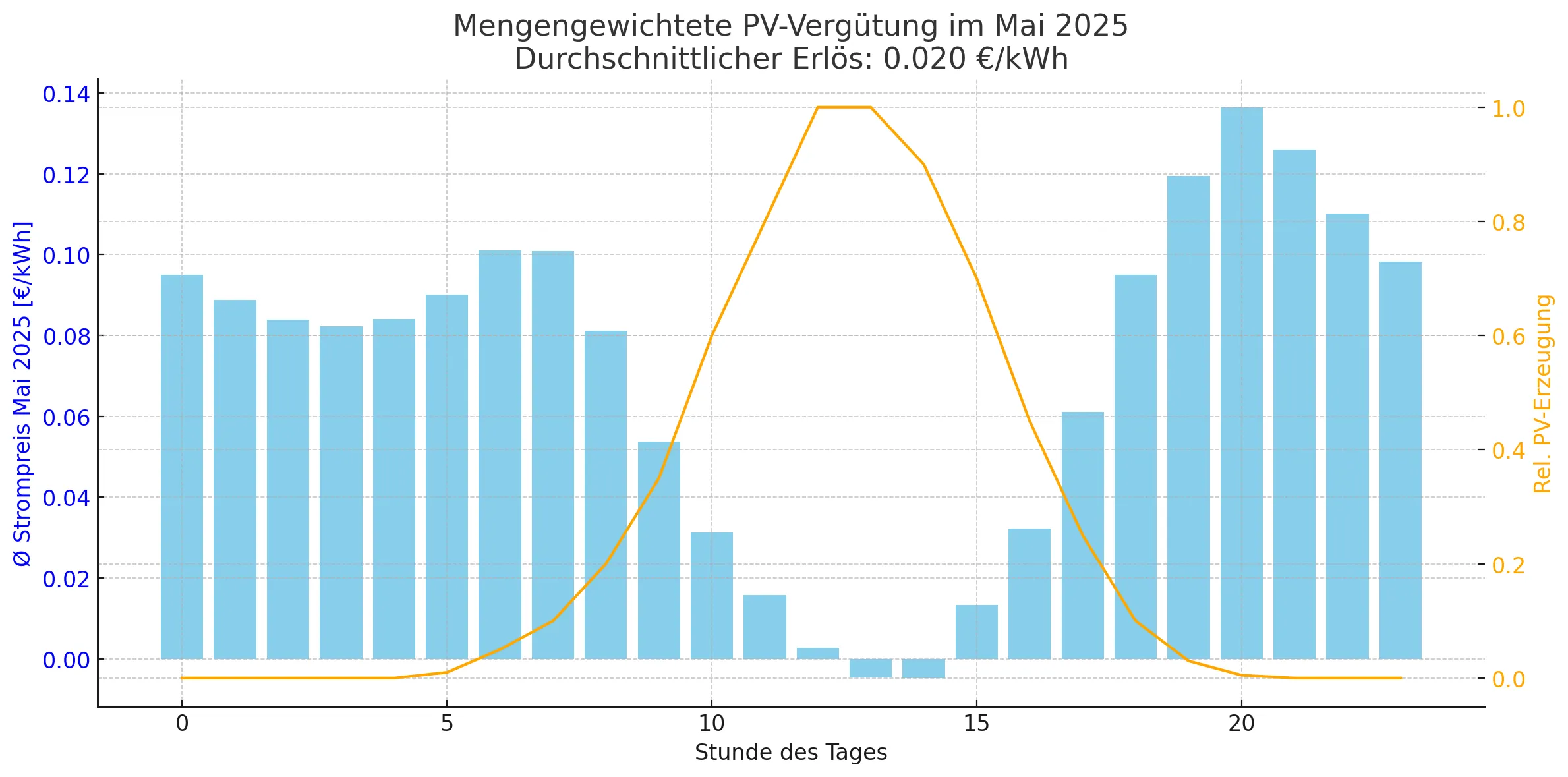
To show this, we combined electricity exchange prices from the first half of 2025 with a realistic PV generation profile. The result is not a theoretical average but the actual, time-weighted value of solar electricity fed into the grid.
| Month | Avg. revenue [€/kWh] |
|---|---|
| January | €0.1365 |
| February | €0.1304 |
| March | €0.0721 |
| April | €0.0344 |
| May | €0.0197 |
| June | €0.0140 |
Price data retrieved from https://www.awattar.at/services/api Generation profile of an east-south-facing PV system located in Upper Carinthia.
What still looks economically sound in winter drops off significantly in spring and early summer. Prices come under pressure especially at midday, when PV systems produce a particularly large amount. In some market phases, they fall to very low levels or even turn negative.
The generation curve becomes a price trap
The economic pressure does not come from individual price spikes but from the structure of the entire system. Photovoltaics typically feeds in heavily at exactly the times when many other systems are also producing a lot. The more PV capacity there is in the market, the more often generation and the price problem coincide.
This is particularly relevant for systems that regularly export their surplus around midday. Exactly where the natural strength of PV lies, its weakness in the market is becoming ever more visible. This is not a technical problem with the system but a market problem of simultaneity.
Why pure feed-in is becoming economically more and more difficult
For many operators, feed-in was long the default path. But this path is becoming less certain because several factors are at work at the same time: more PV capacity in the system, greater price volatility on the spot market, grid congestion and local capacity limits, and the growing importance of flexibility rather than mere generation.
As a result, the simple logic “every additional kilowatt hour is automatically a plus” is losing its validity. Anyone who only produces and feeds in today is much more dependent on market conditions than just a few years ago.
Good to know
The problem is not that PV electricity has become technically worse. On the contrary: it can be generated extremely cheaply. The problem is that many systems follow the same sales logic at the same time. That is exactly what lowers the value of the kilowatt hour fed in.
What to do with electricity that has hardly any market value left?
As soon as surplus electricity can no longer be fed in on economically attractive terms, there are essentially three sensible strategies:
- Curtail
The simplest response. It makes economic sense when additional feed-in brings more problems than revenue. - Shift electrically or thermally
This includes storage, hot water, buffer systems or other controllable loads at the site. - Put it to flexible use
Electricity is channelled locally into an alternative path to value instead of going into the grid across the board.
The best economic solution depends on the site. What is clear, however, is that pure feed-in is less and less often automatically the best path.
Why flexible loads are becoming so important now
Flexible loads fundamentally change the logic of PV systems. They take up electricity exactly when it is available on site and has little value in the market. This not only gives the site more of a logic of its own but often also makes operation economically more stable.
These include heat applications, storage or other dynamically controllable loads. What matters is that these loads do not run rigidly but can respond to the actual availability of surplus. The better this coupling works, the more the dependence on feed-in alone decreases.
Electricity, heat and computing power must be thought of together
At sites with regular surplus in particular, it is often no longer enough to think only in electrical terms. The system only becomes economically interesting when several paths work together: electricity is used locally instead of simply being exported, heat is not given away as a by-product, loads respond dynamically to availability, and utilisation follows the site, not just the grid.
That is precisely the difference between a PV system that produces electricity and a site that manages energy economically.
Why Bitcoin mining fits into this logic at all
Bitcoin mining is often misunderstood in this context. For the economic assessment, what matters is that it is a very flexible load. Its output can be adjusted quickly, surpluses can be absorbed locally and utilisation does not follow the conventional feed-in path.
The point is not that every site automatically needs mining. The point is: in a market where surplus electricity is at times worth very little, flexible loads that can respond quickly become economically more relevant. Mining is one such load – especially when heat can also be put to use.
Heat goes from by-product to economic lever
One of the most frequently underestimated questions is: what actually happens to the heat that is produced?
This is exactly where many sites have an additional lever. If the heat can be integrated into heating, hot water or processes, the result is not only an alternative path for the electricity but also a real cost reduction at the site. Waste heat then becomes a second economic benefit.
This matters because the economics of a system are not decided by a single revenue path. Anyone who monetises surplus electricity locally while also lowering heating costs or thermal expenses values the same kilowatt hour on a broader basis.
The new logic is no longer maximum feed-in but site optimisation
The economic future of many PV systems therefore lies not in ever more feed-in but in better site logic. The decisive questions are: How much surplus arises and when? Which loads can respond to it? What heat can be used? Which parts of the system need to become controllable? Which form of utilisation makes the most economic sense at the site?
Anyone who answers these questions runs their PV system more intelligently, not only technically but also economically.
Conclusion: the new economics of PV come from flexibility
The days of blanket PV feed-in as a sure-fire success are over. Electricity from photovoltaics remains valuable – but this value is less and less often created automatically via the feed-in path. It is created where surplus electricity is used flexibly, locally and in a way that suits the site.
Anyone who wants to run their PV system more economically must therefore look not only at generation but at utilisation. That is where it will be decided in future which sites only get electricity from their system and which turn it into a real business model.


